Featured

Janki Foundation (JF) Annual Lecture: The Psychology of Meditation: Research & Practice

The Psychology of Meditation: Research and Practice
With Professor Michael West and Sister Jayanti
The Janki Foundation Annual Lecture, 27th September 2016, 7pm, GCH, LONDON
SHORT REPORT

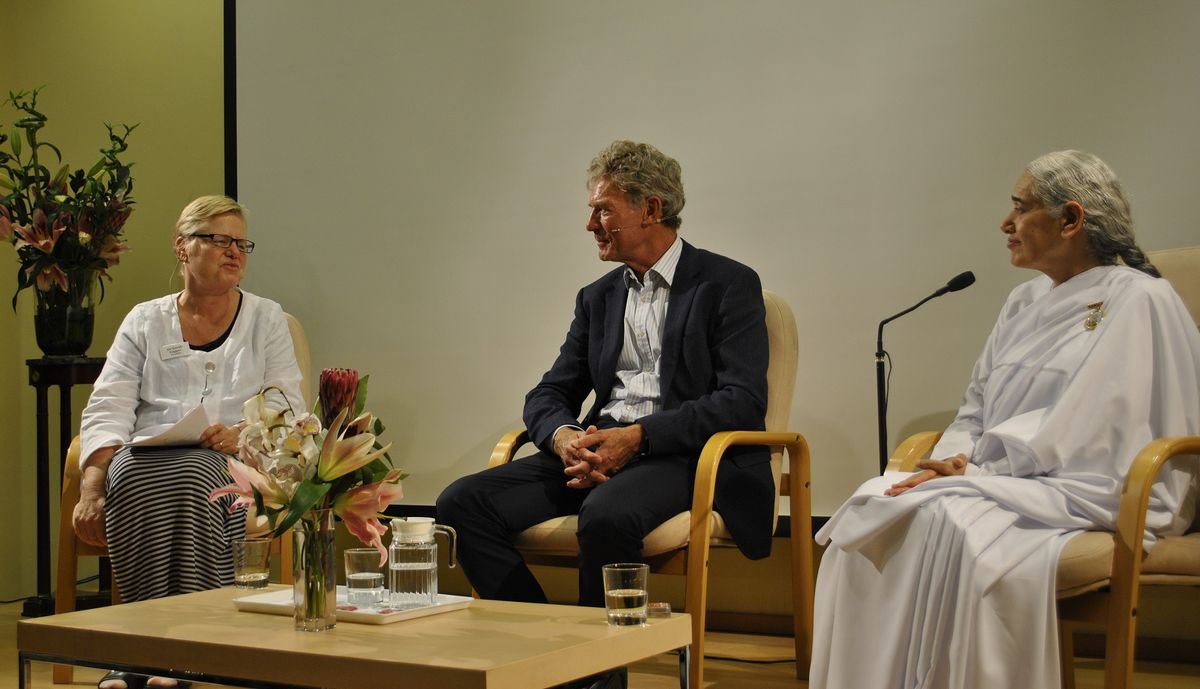
London: With around 240 people present and 50-60 joining online, MC, Consultant Psychiatrist,  Dr Sarah Eagger, introduced the evening led by Professor Michael West, Senior Fellow at The King’s Fund and Professor of Organisational Psychology at Lancaster University Management School, who captivated everyone for 45 minutes with a scholarly and beautifully researched presentation on the therapeutic value of a meditation practice,  as well as the powerful and positive impact a meditation practice can have on any individual’s overall health and well-being. Some of the benefits that were explored by Professor West were how on a personal level meditation can bring about the following:

  • Profound peace of mind
  • Deeper sense of the meaning of existence
  • Connection, compassion and altruism
  • Deeper meaning of existence, insights about the conditioning of the mind.

This was framed by eloquent poems by Dr Rachna Chowla, on the interconnectedness of existence: Come and see and live out of your own story’s mask! 

Then followed a fascinating conversation between Sister Jayanti and Professor West.  Sister Jayanti shared many points on the profound benefits of her many years of experience as a practicing Raj Yogi, including how there are many seeming paradoxes that exist. Professor West had noticed and shared that ‘When I sit by my pond and I feel the wind…..there are times of real stillness which are very here and now, and are filled with feelings of gratitude and love…this then feels transcendent and it is connecting’. 

Sister Jayanti shared how ‘often what it doesn’t say on the tin with secular practices like mindfulness is that it will take you to experiences that are far more meaningful than just the therapeutic experiences.  Mindfulness fits in with Raj Yoga meditation.  There is the experience of Om…I am present…..coming to the awareness of the peace and stillness that sits within’. 

The evening was closed with a meditation commentary by Sister Jayanti, and MC Dr Sarah Eagger thanked both the speakers saying ‘we appreciate your presence and your roles as amazing people doing amazing work in the world’, and thankyous were given to Rachna for the beautiful poetry as well as to the whole organising and production teams for the evening.

ENDS

“Create a peaceful atmosphere by developing a compassionate attitude.” – Dadi Janki, President of Janki Foundation

The Janki Foundation for Spirituality in Healthcare
Moran House, First Floor, Suite 12
449/451 High Road
London NW10 2JJ, UK
T: +44 (0)20 8459 1400
E: bhavna.patani@jankifoundation.org
W: www.jankifoundation.org
Skype: bhavna.patani
What is Counseling Psychology ?

Counseling Psychology is a specialty within professional psychology that maintains a focus on facilitating personal and interpersonal functioning across the life span.  The specialty  pays particular attention to emotional, social, vocational, educational, health-related, developmental, and organizational concerns.

The practice of Counseling Psychology encompasses a broad range of culturally-sensitive practices that help people improve their well-being, alleviate distress and maladjustment, resolve crises, and increase their ability to function better in their lives. With its  attention to both to normal developmental issues and problems associated with physical, emotional, and mental disorders, the specialization holds a unique perspective in the broader practice-based areas of psychology.

Counseling Psychologists serve persons of all ages and cultural backgrounds in both individual and group settings. They also consult regularly with organizations seeking to enhance their effectiveness or the well-being of their members.

Interventions used by Counseling Psychologists may be either brief or long-term; they are often problem-specific and goal-directed. These activities are guided by a philosophy that values individual differences and diversity and a focus on prevention, development, and adjustment across the life-span.

Check out this infographic on counseling psychology:

Counseling Psychology is a specialty within professional psychology that maintains a focus on facilitating personal and interpersonal functioning across the life span.  The specialty  pays particular attention to emotional, social, vocational, educational, health-related, developmental, and organizational concerns.

The practice of Counseling Psychology encompasses a broad range of culturally-sensitive practices that help people improve their well-being, alleviate distress and maladjustment, resolve crises, and increase their ability to function better in their lives. With its  attention to both to normal developmental issues and problems associated with physical, emotional, and mental disorders, the specialization holds a unique perspective in the broader practice-based areas of psychology.

Counseling Psychologists serve persons of all ages and cultural backgrounds in both individual and group settings. They also consult regularly with organizations seeking to enhance their effectiveness or the well-being of their members.

Interventions used by Counseling Psychologists may be either brief or long-term; they are often problem-specific and goal-directed. These activities are guided by a philosophy that values individual differences and diversity and a focus on prevention, development, and adjustment across the life-span.

Check out this info graphic on counseling psychology:

Introduce Yourself (Example Post)

This is an example post, originally published as part of Blogging University. Enroll in one of our ten programs, and start your blog right.

You’re going to publish a post today. Don’t worry about how your blog looks. Don’t worry if you haven’t given it a name yet, or you’re feeling overwhelmed. Just click the “New Post” button, and tell us why you’re here.

Why do this?

  • Because it gives new readers context. What are you about? Why should they read your blog?
  • Because it will help you focus you own ideas about your blog and what you’d like to do with it.

The post can be short or long, a personal intro to your life or a bloggy mission statement, a manifesto for the future or a simple outline of your the types of things you hope to publish.

To help you get started, here are a few questions:

  • Why are you blogging publicly, rather than keeping a personal journal?
  • What topics do you think you’ll write about?
  • Who would you love to connect with via your blog?
  • If you blog successfully throughout the next year, what would you hope to have accomplished?

You’re not locked into any of this; one of the wonderful things about blogs is how they constantly evolve as we learn, grow, and interact with one another — but it’s good to know where and why you started, and articulating your goals may just give you a few other post ideas.

Can’t think how to get started? Just write the first thing that pops into your head. Anne Lamott, author of a book on writing we love, says that you need to give yourself permission to write a “crappy first draft”. Anne makes a great point — just start writing, and worry about editing it later.

When you’re ready to publish, give your post three to five tags that describe your blog’s focus — writing, photography, fiction, parenting, food, cars, movies, sports, whatever. These tags will help others who care about your topics find you in the Reader. Make sure one of the tags is “zerotohero,” so other new bloggers can find you, too.

Design a site like this with WordPress.com
Get started